Businesses are under constant pressure to reduce operational costs while simultaneously improving productivity, customer experience, and profitability. As economic uncertainty, labor shortages, and increasing customer expectations continue to challenge organizations, business leaders are actively searching for smarter ways to optimize operations. Consequently, automation has become one of the most effective strategies for achieving sustainable growth and operational efficiency.
However, a critical question continues to emerge among decision-makers: AI vs Traditional Automation—which saves more money? While traditional automation has helped businesses streamline repetitive tasks for decades, modern artificial intelligence is transforming automation by introducing learning, prediction, adaptation, and decision-making capabilities. As a result, organizations are reevaluating their automation strategies to determine which approach delivers the greatest return on investment.
Although both technologies aim to reduce manual effort and improve efficiency, they differ significantly in capabilities, implementation costs, scalability, maintenance requirements, and long-term business value. Therefore, understanding the differences between AI and traditional automation is essential before making investment decisions.
In this comprehensive guide, we will examine the true cost-saving potential of AI automation compared to traditional automation, explore the underlying technologies and AI algorithms, analyze real-world business scenarios, and help organizations determine which solution provides the greatest financial impact in 2026 and beyond.
Understanding Traditional Automation
For many years, traditional automation has served as the foundation of digital transformation initiatives. Typically, traditional automation relies on predefined rules, structured workflows, and repetitive processes that follow a fixed set of instructions.
For example, when an invoice arrives, the system automatically routes it for approval. Similarly, when a customer submits a form, the workflow triggers a predefined sequence of actions. Therefore, traditional automation excels in environments where tasks are predictable, repetitive, and highly structured.
How Traditional Automation Works
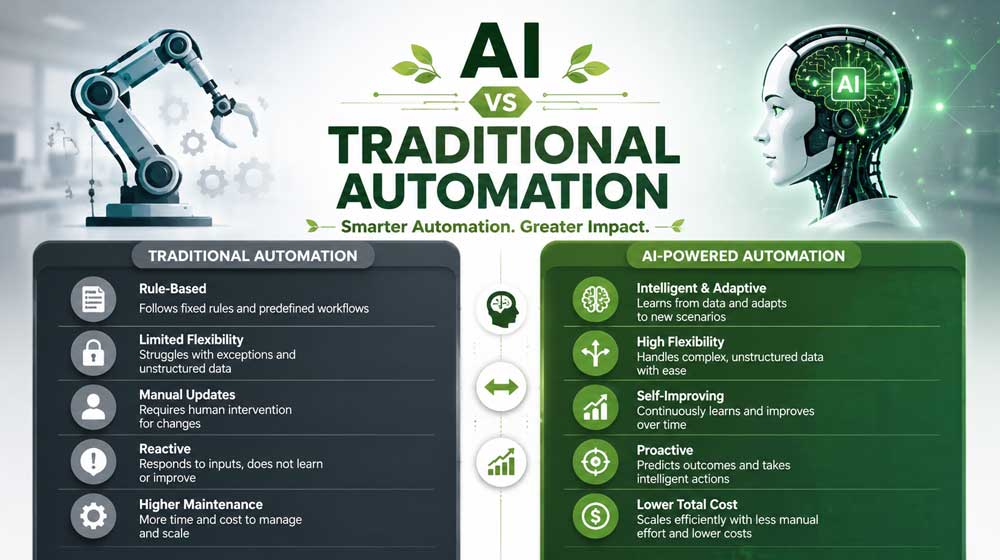
Traditional automation systems operate based on “if-then” logic. Consequently, they require clear rules and structured inputs. Whenever business processes remain consistent and rarely change, traditional automation can significantly reduce manual effort and operational costs.
However, challenges arise when businesses encounter exceptions, unstructured data, changing customer behaviors, or complex decision-making requirements. In such situations, traditional automation often requires manual intervention, additional programming, or workflow redesign.
Understanding AI Automation
Unlike traditional automation, AI automation goes beyond fixed rules. Instead, it leverages machine learning, natural language processing, computer vision, predictive analytics, and large language models to analyze data, learn from patterns, and continuously improve performance.
As a result, AI automation can handle dynamic business environments where conditions frequently change. Furthermore, it can process unstructured information such as emails, customer conversations, documents, images, and market data.
How AI Automation Works
AI automation combines multiple technologies to create intelligent workflows. Machine learning algorithms identify patterns in historical data. Natural language processing enables systems to understand human language. Predictive analytics forecasts future outcomes. Meanwhile, large language models generate contextual responses and insights.
Consequently, AI systems can make informed decisions without requiring extensive manual programming for every possible scenario.

AI vs Traditional Automation: The Cost Comparison
One of the biggest misconceptions is that traditional automation is always cheaper. While initial implementation costs may appear lower, long-term financial impact often tells a different story.
Initial Investment Costs
Traditional automation generally requires lower upfront investment because businesses only need workflow design, process mapping, and rule configuration. Therefore, smaller organizations often view it as the more affordable option.
On the other hand, AI automation may involve investments in data preparation, model training, integration, and infrastructure. Consequently, implementation costs are usually higher during the initial stages.
Operational Costs
Although traditional automation may be less expensive initially, maintenance costs often increase over time. Every workflow modification, business rule update, or process change may require developer involvement.
In contrast, AI systems continuously learn and adapt. Therefore, businesses often experience lower maintenance costs and greater operational flexibility in the long term.
Labor Cost Reduction
Traditional automation eliminates repetitive tasks. However, AI automation eliminates repetitive tasks while simultaneously augmenting human decision-making.
Consequently, organizations frequently achieve significantly greater labor savings through AI because employees can focus on strategic initiatives rather than routine operational activities.
Where Traditional Automation Still Wins
Traditional automation remains highly effective for structured processes such as payroll processing, invoice routing, inventory updates, compliance workflows, and predefined approval chains.
Therefore, businesses with highly standardized operations may continue to benefit from traditional automation solutions.
Furthermore, implementation is often faster and requires less organizational change management.
Where AI Automation Delivers Greater Savings
AI automation excels when organizations face complex challenges involving customer service, fraud detection, demand forecasting, predictive maintenance, marketing optimization, and business intelligence.
For example, customer support teams can reduce costs dramatically by implementing AI-powered virtual assistants capable of resolving inquiries without human intervention.
Similarly, predictive analytics can identify revenue opportunities and operational risks before they impact profitability.

AI Algorithms Driving Modern Cost Savings
Machine Learning
Machine learning models identify patterns and optimize processes automatically. Consequently, businesses reduce errors, improve forecasting accuracy, and increase productivity.
Natural Language Processing
NLP enables systems to understand and respond to customer requests. Therefore, support teams can handle larger volumes of inquiries with fewer resources.
Predictive Analytics
Predictive analytics helps organizations anticipate future outcomes. As a result, businesses reduce waste, improve inventory management, and optimize resource allocation.
Computer Vision
Computer vision automates inspections, quality control, and document processing. Consequently, organizations reduce labor-intensive manual reviews.
Large Language Models
Large language models enhance knowledge management, customer support, content generation, and internal productivity. Therefore, businesses can automate tasks that previously required specialized expertise.
The Hidden Costs Businesses Often Ignore
Many organizations focus solely on implementation expenses while overlooking hidden operational costs.
Traditional automation often requires frequent updates, workflow redesigns, and manual exception handling. Consequently, total ownership costs may increase over time.
Meanwhile, AI automation may require data governance, model monitoring, and ongoing optimization. However, these investments frequently generate higher returns through improved efficiency and decision-making capabilities.
Which Businesses Benefit Most From Traditional Automation?
Small organizations with stable workflows and predictable processes often achieve excellent results through traditional automation.
Manufacturing operations, accounting workflows, and routine administrative functions are examples where traditional automation continues to deliver strong ROI.
Which Businesses Benefit Most From AI Automation?
Organizations experiencing rapid growth, high customer interaction volumes, complex decision-making requirements, and large-scale data processing often benefit more from AI automation.
Financial services, healthcare, e-commerce, logistics, customer support, and technology companies are among the industries experiencing significant cost reductions through AI-driven solutions.
AI vs Traditional Automation: The Final Verdict
When evaluating AI vs Traditional Automation, the answer ultimately depends on business objectives, operational complexity, and long-term growth plans.
For simple, structured, and repetitive processes, traditional automation remains a cost-effective solution. However, for businesses seeking scalability, predictive intelligence, adaptive workflows, and greater long-term cost savings, AI automation increasingly delivers superior value.
As organizations continue their digital transformation journeys, the most successful companies are not choosing one approach over the other. Instead, they are strategically combining traditional automation with AI-powered intelligence to create highly efficient, scalable, and future-ready operations.
Conclusion
The debate surrounding AI vs Traditional Automation is no longer about which technology is better. Instead, it is about identifying the right solution for specific business challenges. While traditional automation continues to provide value for structured workflows, AI automation is redefining what businesses can achieve through intelligent decision-making, predictive capabilities, and continuous learning.
Therefore, organizations that strategically invest in automation today will be better positioned to reduce costs, increase efficiency, improve customer experiences, and achieve sustainable growth in the years ahead.