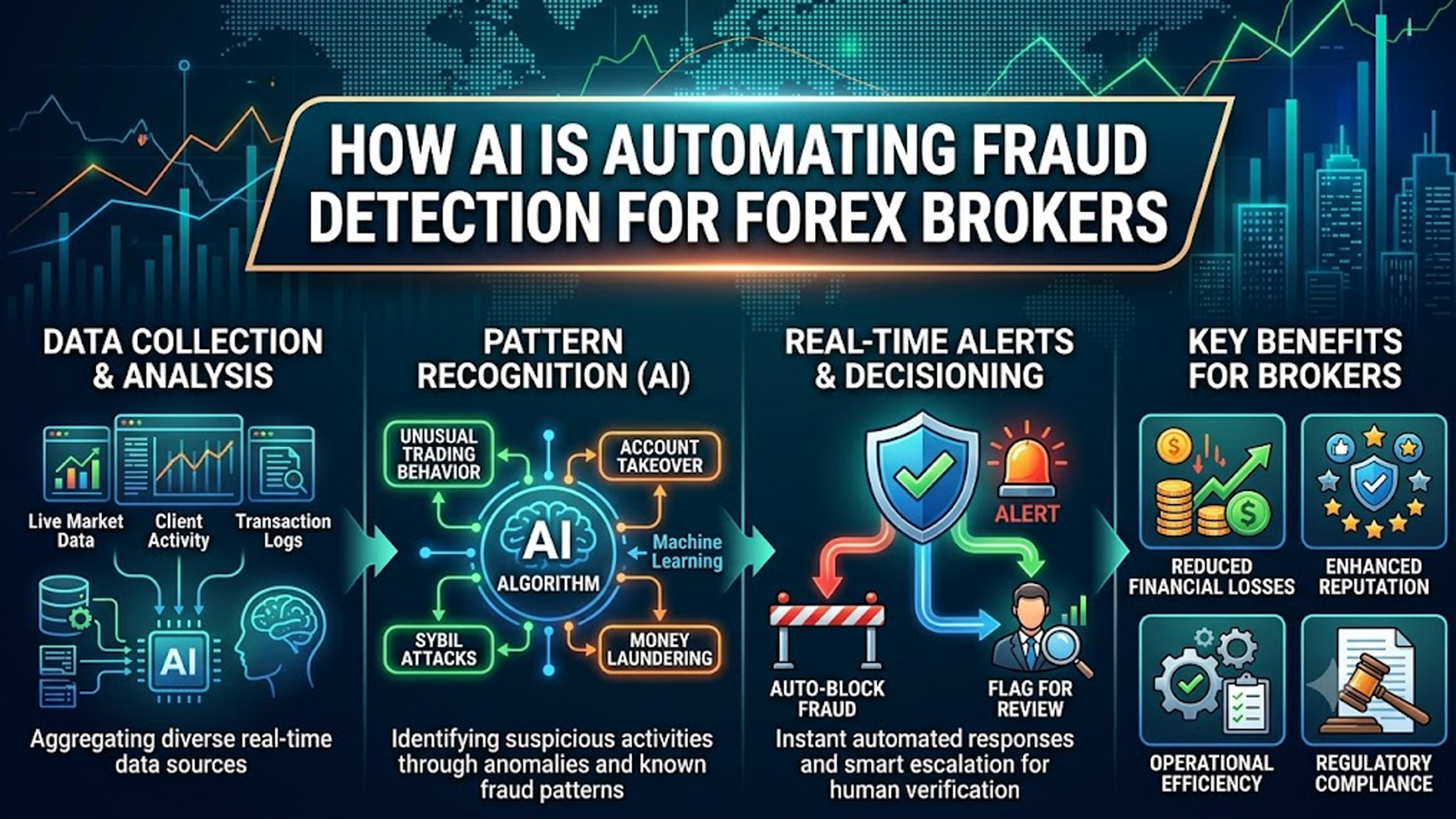
The global forex market processes more than $7.5 trillion in daily trading volume, making it the largest financial market in the world. However, as trading volumes continue to rise, fraudulent activities are increasing at an equally alarming rate. Today, forex brokers face sophisticated threats ranging from account takeovers and identity fraud to money laundering, bonus abuse, payment fraud, and algorithmic trading manipulation.
Consequently, traditional fraud detection methods are no longer sufficient. Manual monitoring systems often fail to identify complex fraud patterns in real time. Furthermore, rule-based systems generate excessive false positives, resulting in operational inefficiencies and poor customer experiences.
As a result, leading forex brokers are rapidly adopting Artificial Intelligence (AI) and Machine Learning (ML) technologies to strengthen fraud prevention frameworks. AI-powered fraud detection systems analyze millions of transactions, trading activities, behavioral patterns, and user interactions in real time, enabling brokers to identify suspicious activities before significant financial losses occur.
In this comprehensive guide, we will explore how AI is transforming fraud detection for forex brokers, the challenges brokers currently face, the technologies driving this transformation, and how modern AI algorithms help create a safer and more compliant trading environment.
Why Fraud Is Becoming a Critical Challenge for Forex Brokers
The forex industry has experienced significant digital transformation over the last decade. While this evolution has improved accessibility and customer onboarding, it has simultaneously created new opportunities for cybercriminals.
Today, fraudsters leverage advanced technologies, automation tools, synthetic identities, VPN networks, bot farms, and stolen credentials to exploit brokerage platforms. Therefore, brokers are under constant pressure to detect and prevent fraudulent activities without disrupting legitimate customer experiences.
Moreover, regulatory authorities across multiple jurisdictions now require brokers to implement robust anti-money laundering (AML), Know Your Customer (KYC), and transaction monitoring systems. Failure to comply often results in substantial fines, license suspensions, and reputational damage.
Consequently, brokers need intelligent systems capable of adapting to emerging threats in real time.
The Most Common Types of Forex Broker Fraud
Forex brokers encounter various forms of fraud that impact revenue, compliance, and customer trust.
Identity fraud remains one of the most prevalent challenges. Fraudsters frequently use stolen documents, synthetic identities, and manipulated verification records to create fraudulent trading accounts.
Additionally, account takeover attacks continue to increase. Criminals gain unauthorized access to trader accounts through phishing campaigns, credential stuffing, or malware infections. Once access is obtained, funds can be withdrawn or manipulated rapidly.
Bonus abuse also presents a significant concern. Many fraudsters create multiple accounts to exploit promotional campaigns and referral programs. As a result, brokers suffer substantial financial losses while legitimate traders experience reduced promotional benefits.
Furthermore, money laundering activities remain a major compliance risk. Criminal organizations often use trading platforms to move illicit funds through seemingly legitimate transactions.
Meanwhile, payment fraud involving stolen cards, chargeback abuse, and unauthorized payment methods creates additional operational challenges.
Because these threats continuously evolve, traditional security solutions struggle to keep pace.
Why Traditional Fraud Detection Systems Are Failing
Historically, forex brokers relied on rule-based fraud detection systems. These systems operate using predefined conditions such as:
- Large withdrawal amounts
- Multiple login attempts
- High-frequency trading behavior
- Unusual account activity
Although these rules provide a basic layer of protection, they cannot adapt to evolving fraud techniques.
For example, fraudsters continuously modify their behavior to bypass static rules. Therefore, systems based solely on predefined thresholds often miss sophisticated attacks.
At the same time, traditional systems generate excessive false alerts. Consequently, compliance teams spend significant time reviewing legitimate activities rather than focusing on genuine threats.
Furthermore, manual investigation processes delay response times. By the time suspicious activity is identified, financial damage may already have occurred.
Therefore, brokers require adaptive technologies capable of learning from data patterns and responding instantly.
How AI Is Revolutionizing Fraud Detection for Forex Brokers
Artificial Intelligence fundamentally changes fraud detection by enabling systems to learn, adapt, and improve continuously.
Unlike traditional systems, AI analyzes enormous volumes of structured and unstructured data simultaneously. As a result, it identifies hidden patterns that human analysts and rule-based systems often overlook.
More importantly, AI continuously refines its detection capabilities as new fraud scenarios emerge.
Real-Time Behavioral Analysis
One of the most powerful applications of AI in forex brokerage operations is behavioral analytics.
Every trader exhibits unique behavioral patterns. These patterns include:
- Login frequency
- Trading preferences
- Device usage
- Geographic location
- Transaction habits
- Navigation behavior
AI systems establish behavioral baselines for each customer. Subsequently, when unusual behavior occurs, the system immediately flags potential fraud risks.
For instance, if a trader who normally accesses an account from London suddenly logs in from multiple countries within a short period, AI can detect the anomaly instantly.
Consequently, brokers can intervene before unauthorized activities escalate.
Machine Learning-Based Anomaly Detection
Machine learning algorithms excel at identifying anomalies hidden within large datasets.
Instead of relying on predefined rules, these algorithms learn from historical trading data and continuously recognize unusual patterns.
For example, AI can identify:
- Unusual trade execution patterns
- Abnormal deposit behaviors
- Suspicious withdrawal requests
- Coordinated account activities
- High-risk transaction sequences
As the system processes additional data, detection accuracy improves significantly.
Therefore, brokers benefit from stronger protection while reducing false positives.
AI Models Used in Modern Forex Fraud Detection
Modern fraud detection platforms leverage multiple AI models working together to maximize accuracy.
Supervised Machine Learning Models
Supervised learning algorithms are trained using historical fraud cases.
These models analyze previously identified fraudulent and legitimate transactions. Subsequently, they learn to classify future activities accordingly.
Common algorithms include:
- Random Forest
- Gradient Boosting
- XGBoost
- Logistic Regression
- Neural Networks
Because these models learn from real-world fraud examples, they achieve high prediction accuracy.
Unsupervised Learning Models
Unsupervised learning focuses on discovering unknown fraud patterns.
Since fraud techniques evolve rapidly, brokers cannot always provide labeled datasets for training.
Therefore, unsupervised algorithms identify unusual clusters and hidden relationships automatically.
Popular models include:
- K-Means Clustering
- Isolation Forest
- Autoencoders
- Density-Based Clustering
These models are particularly effective at detecting emerging fraud strategies.
Deep Learning Networks
Deep learning models process massive datasets with exceptional precision.
Through multiple neural network layers, these systems identify complex relationships between transactions, user behavior, and account activities.
Consequently, deep learning significantly improves fraud detection capabilities in high-volume brokerage environments.
Reinforcement Learning Systems
Reinforcement learning enables AI systems to continuously optimize decision-making.
Whenever the system successfully identifies fraud, it receives positive feedback. Conversely, inaccurate predictions trigger corrective adjustments.
As a result, detection performance improves over time without extensive manual intervention.
AI-Powered KYC Verification and Identity Fraud Prevention
Identity verification remains one of the most critical stages in fraud prevention.
Traditional document verification processes often require extensive manual reviews. Consequently, onboarding delays frustrate legitimate customers while creating opportunities for fraudsters.
AI-powered KYC solutions solve this challenge through automated verification workflows.
These systems analyze:
- Government-issued IDs
- Passports
- Driver licenses
- Utility bills
- Selfie verification
- Biometric authentication
Advanced computer vision algorithms verify document authenticity within seconds.
Simultaneously, facial recognition technology compares live images against submitted documents.
Therefore, brokers can dramatically reduce onboarding fraud while improving customer experiences.
AI and Anti-Money Laundering (AML) Compliance
AML compliance remains a top priority for regulated forex brokers.
Traditional AML monitoring systems often struggle with transaction complexity and volume.
However, AI-powered AML systems continuously analyze:
- Transaction flows
- Deposit sources
- Withdrawal patterns
- Cross-border activities
- Account relationships
Consequently, suspicious activities are identified much faster.
Furthermore, network analysis algorithms uncover hidden relationships between accounts involved in laundering schemes.
As a result, compliance teams gain deeper visibility into potential risks while reducing manual workload.