Starting a forex brokerage business in India is often seen as a high-revenue opportunity. However, unlike many global jurisdictions, India has a tightly regulated financial system. Therefore, understanding the real cost of a forex broker license in India requires more than just numbers—it requires clarity on regulations, compliance, and business structure.
In 2026, launching a forex brokerage is not just about obtaining a license. Instead, it is about building a legally compliant, technology-driven, and user-focused financial platform. If you approach it correctly, you can create a scalable and profitable business. However, if you ignore regulatory realities, the entire venture can collapse before it even starts.
This complete guide explains everything in detail, including licensing costs, hidden expenses, legal frameworks, and strategies to optimize your investment.
Understanding Forex Trading Legality in India
Before diving into costs, it is important to understand a critical fact—forex trading in India is highly regulated and restricted.
In India, forex trading is only legally allowed through recognized exchanges such as National Stock Exchange and Bombay Stock Exchange. Additionally, trading is limited to specific currency pairs that include INR.
This regulatory structure is controlled by Reserve Bank of India and Securities and Exchange Board of India.
As a result, independent forex broker licenses (like offshore brokers) are not directly issued in India. Therefore, if you want to start a forex brokerage, you must follow one of the legally accepted business models.
Why Forex Broker License Cost in India Is Different
Unlike countries such as UAE or offshore jurisdictions, India does not provide a straightforward forex broker license for retail trading.
Instead, businesses operate under:
- Authorized dealer licenses (for banks)
- Brokerage partnerships with registered entities
- Exchange-based trading models
Because of this structure, the cost is not a single license fee. Rather, it is a combination of compliance, partnership, and infrastructure costs.
Therefore, understanding the structure is essential before estimating the total investment.
Business Models for Forex Brokerage in India
To operate legally, you must choose the right business model. Each model has a different cost structure and regulatory requirement.
The most common approach is becoming a sub-broker or partner with a SEBI-registered broker. This allows you to offer forex trading services without directly holding a license.
Another model involves setting up an offshore forex brokerage while targeting global clients. However, this approach comes with legal and banking complexities if you operate from India.
A third approach is launching an exchange-integrated platform that connects users to regulated Indian exchanges.
Among these, the partnership model is the most practical and widely used in India.
Complete Cost Breakdown of Forex Broker Setup in India (2026)
Since there is no direct forex broker license, the cost is distributed across multiple components.
The first major cost is company registration. Setting up a private limited company in India involves legal documentation, compliance filings, and administrative expenses. Although this cost is relatively moderate, it is essential for establishing your business.
Next comes broker partnership or franchise cost. If you choose to partner with a registered broker, you may need to pay an onboarding or revenue-sharing fee. This cost varies depending on the broker and the services offered.
Technology infrastructure is another significant expense. You need a trading platform, CRM system, and user dashboard. Many businesses use white-label solutions to reduce development costs, while others invest in custom platforms for better control.
Compliance costs form a critical part of your investment. Even as a partner, you must follow KYC and AML regulations. This includes identity verification systems, transaction monitoring, and reporting mechanisms.
Marketing and user acquisition also require a substantial budget. Without visibility, your platform cannot attract traders. Therefore, investing in SEO, paid ads, and content marketing is necessary.
Operational costs such as staff salaries, customer support, and maintenance must also be considered. These recurring expenses play a major role in long-term sustainability.
Overall, the total cost of starting a forex brokerage business in India can range from ₹10 lakhs to ₹50 lakhs or more, depending on your scale and strategy.

Hidden Costs You Must Consider
Many entrepreneurs underestimate hidden costs, which often leads to financial strain.
Banking setup is one of the biggest challenges. Since forex trading is tightly regulated, banks may require additional documentation and compliance checks before approving your account.
Legal consultation is another ongoing expense. Regulations frequently change, and staying compliant requires expert guidance.
Payment gateway integration can also be costly, especially if you need international transaction support.
In addition, customer acquisition costs can increase significantly if your marketing strategy is not optimized.
Therefore, planning for these hidden expenses ensures smoother operations and avoids unexpected financial pressure.
Step-by-Step Process to Start a Forex Brokerage in India
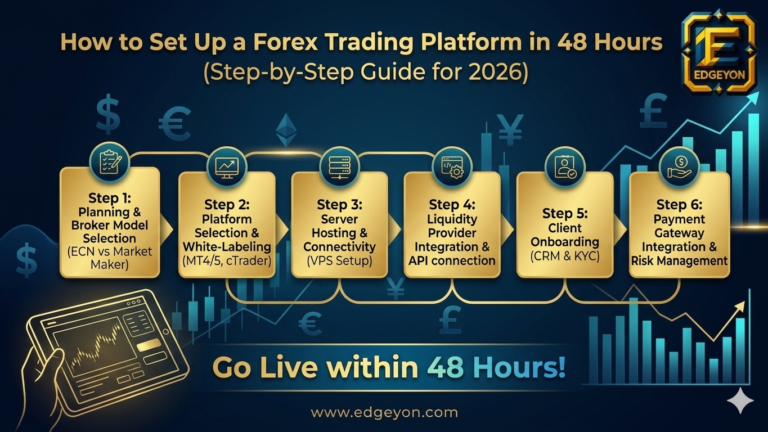
The process begins with defining your business model. You must decide whether you are operating as a partner, independent platform, or global brokerage.
Once your model is finalized, you need to register your company and complete all legal formalities. This step establishes your business identity and allows you to proceed further.
The next stage involves selecting a broker partner or technology provider. This decision directly impacts your cost, scalability, and user experience.
After that, you must implement KYC and compliance systems. Even if you are not directly regulated, compliance is essential for building trust and avoiding legal issues.
Platform development or integration follows next. Whether you choose a white-label solution or a custom platform, your focus should be on performance and usability.
Finally, once everything is in place, you can launch your platform and begin marketing your services to attract users.
Role of AI in Reducing Forex Brokerage Costs
In 2026, AI plays a crucial role in optimizing costs and improving efficiency.
AI-powered systems can automate KYC verification, reducing manual effort and processing time. At the same time, fraud detection algorithms help prevent financial losses by identifying suspicious activities.
AI also enhances user experience by analyzing trading behavior and providing personalized insights. This increases user engagement and retention.
As a result, businesses that integrate AI can operate more efficiently while delivering a superior user experience.
Challenges in Starting a Forex Brokerage in India
Despite the opportunities, several challenges must be addressed.
Regulatory restrictions are the biggest hurdle. Since India does not allow independent forex brokers, businesses must operate within a limited framework.
User trust is another challenge. Many traders are cautious due to scams and unregulated platforms. Therefore, transparency and compliance are essential.
Competition is also increasing as more businesses enter the market. Differentiation becomes critical for attracting and retaining users.
However, with the right strategy, these challenges can be effectively managed.
Future of Forex Brokerage in India
The future of forex trading in India is expected to evolve gradually. As global markets expand and technology advances, regulations may become more structured and supportive.
At the same time, digital platforms and AI-driven solutions will continue to transform the trading experience. Businesses that adapt to these changes early will have a significant advantage.
Moreover, increasing awareness among traders will drive demand for reliable and user-friendly platforms.
Final Thoughts: Is It Worth Starting a Forex Brokerage in India?
Starting a forex brokerage in India is not a straightforward process, but it is still a viable opportunity if approached correctly.
Instead of focusing only on licensing, you should focus on building a compliant, technology-driven, and user-centric platform. By choosing the right business model, optimizing costs, and leveraging AI, you can create a scalable and profitable business.
Ultimately, success in this industry depends on understanding regulations, building trust, and delivering a seamless user experience. If you can achieve these, your forex brokerage can thrive in the competitive Indian market.